
January 23, 2026
There is little doubt that 2026 will bring news of continuing government interest in Medicare Advantage fraud enforcement. DOJ, HHS-OIG, Congress, and others have all declared this to be a priority. In fact, the year started out with a bang with a record-setting $556 million settlement with Kaiser Permanente centered on Kaiser’s Medicare Advantage coding practices. As set out below, the Kaiser False Claims Act (“FCA”) settlement is just the latest in a line of Medicare Advantage fraud enforcement actions. More are likely on the way.
Medicare Advantage, or Medicare “Part C,” is a part of Medicare in which private insurers contract with the government to manage the care of Medicare beneficiaries. A Medicare-eligible beneficiary can opt to enroll in a Medicare Advantage Plan instead of the traditional Medicare program. The Medicare Advantage plan is run by private insurers (the Medicare Advantage insurer). In turn, the government pays the Medicare Advantage insurer a pre-determined per-person rate for each Medicare beneficiary it enrolls. The payment amount is tied to a beneficiary’s “risk score.” The risk score is based primarily on the patient’s medical diagnoses, not on the actual services an enrollee uses during the Plan year. Because enrollees with higher risk scores cost more to treat, the government pays higher per-person rates for enrollees who are projected to be sicker in the near future than for the average enrollee under traditional Medicare or Medicaid.
The government relies on medical providers and Medicare Advantage Plans to submit truthful and accurate diagnosis information for the patients in their care. After all, the payments to the MA insurer are based on those diagnoses. To ensure the integrity of the system, CMS has implemented specific rules regarding the submission of encounter data. Yet despite these rules, schemes to inflate a patient’s risk score by submitting inaccurate encounter data are all too common. The New York Times, the Wall Street Journal, and others have reported on this issue.
Ultimately, whistleblowers sounded the alarm, filing numerous qui tam actions that have led, as detailed below, to significant recoveries and jump-started the government’s efforts in Medicare Advantage fraud enforcement. As a result, we have seen three distinct waves of Medicare Advantage Fraud Enforcement, with potentially more to come.
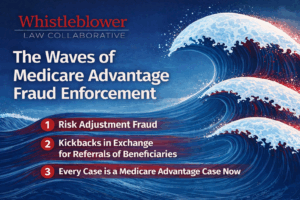
The first wave of Medicare Advantage FCA cases centered on the role that diagnosis codes played in setting the amount that the government paid to Medicare Advantage insurers. These cases are known as “risk adjustment” cases. They generally involved a Medicare Advantage insurer submitting a false and/or unsupported diagnosis code in order to increase reimbursement. Defendants included Medicare Advantage insurers, as well as healthcare providers.
The United States’ recent $556 million settlement with Kaiser Permanente is the largest of these cases to date. The government alleged that Kaiser systematically pressured its physicians to alter medical records after patient visits to add diagnoses. The physicians, however, had not considered or addressed those conditions at those visits. Accordingly, the government alleged that these code submissions violated CMS rules. As alleged, Kaiser singled out underperforming physicians and facilities and emphasized that the failure to add diagnoses cost money for Kaiser, the facilities, and the physicians themselves. WLC’s Erica Blachman Hitchings was the initial Assistant U.S. Attorney assigned to the Kaiser Medicare Advantage investigation. She continued to lead and work on the investigation until her departure from the DOJ in 2018, at which time she joined WLC.
The United States intervened in an FCA qui tam lawsuit against Sutter Health Inc. and one of its affiliates. The lawsuit alleged that Sutter Health and the affiliate medical group knowingly submitted unsupported diagnosis codes for certain patient encounters. These unsupported diagnosis scores allegedly inflated the risk scores of Plan beneficiaries, resulting in inflated payments to the Plan and then to Sutter. The lawsuit further alleges that once the Sutter entities became aware of these unsupported diagnosis codes, they failed to take sufficient corrective action. For example, they failed to delete additional potentially unsupported diagnosis codes. In August 2021, the United States resolved these allegations as part of a $90 million settlement with Sutter Health. WLC’s Erica Blachman Hitchings led this investigation for the United States as well.
Martin’s Point Health Care Inc., a Medicare Part C Plan, engaged in chart reviews of its beneficiaries. The chart reviews were done to identify additional diagnoses codes that could be submitted to Medicare. The whistleblower, however, alleged that many of the patients’ medical records did not support these additional codes. Martin’s Point agreed to pay $22.5 million to settle the claims.
HealthCare Partners Holdings LLC (HCP), doing business as DaVita Medical Holdings LLC, a large California-based independent physician association, paid $270 million under the FCA for allegedly providing inaccurate information that caused MCOs to receive inflated Medicare payments. As part of that scheme, HCP engaged in “one-way” patient chart reviews to add diagnoses that would boost its Medicare revenue without deleting any inaccurate diagnosis codes it discovered.
The United States intervened and later settled an FCA qui tam lawsuit against The Cigna Group, a Medicare Advantage provider, for submitting false diagnoses codes to increase their capitated payments from CMS. The Government’s Complaint alleged that the invalid diagnosis codes were based solely on forms completed by vendors retained and paid by CIGNA to conduct in-home assessments of plan members. In 2023, CIGNA paid $172 million in settlement of the claims.
The second wave of Medicare Advantage fraud enforcement involves kickbacks. Under the per capita payment system, each Medicare Advantage beneficiary represents a lucrative financial opportunity for insurers and physicians alike. Unfortunately, this has led numerous insurance companies, brokers, and even physicians to use financial incentives to ensure MA beneficiaries are steered to them.
Recognizing this troublesome behavior, HHS-OIG issued a Special Fraud Alert in December 2024. The alert is titled “Suspect Payments in Marketing Arrangements Related to Medicare Advantage and Providers.” We detailed the alert and its related issues in a previous post and wrote about it for Law360. To summarize, the Alert sheds light on “abusive compensation agreements” and marketing schemes involving “questionable payments and referrals.” HHS-OIG warned that such practices can result in improper patient steering, anticompetitive conduct, and other harms to enrollees and to the Medicare program. Moreover, the schemes may implicate and violate the Anti-Kickback Statute.
The alert addresses several types of arrangements. The first category involves payments from a Medicare Advantage insurer to a provider and/or their staff. In exchange, the provider refers patients to the Plan. The second category entails payments from a provider to an insurance broker or agency. These payments are in exchange for brokers steering beneficiaries to these providers. A third type of payment includes payments from a MA insurer to an insurance broker or agency in exchange for enrollments. (The Alert references this type of payment in a footnote; it is the subject of at least one ongoing litigation by the U.S. and a whistleblower).
In U.S. ex rel. Butler v. Shikara, et al., the whistleblowers alleged that multiple MAOs paid kickbacks to a doctor and brokerage he controlled in exchange for steering beneficiaries and patients to their plans. The government declined to intervene, but the relator continued the litigation. The Court denied Defendants’ motions to dismiss and for summary judgment. (WLC was proud to represent the whistleblowers in this case. You can read more about it here.)
MMM Holdings, Inc. paid $15.2 million to resolve allegations that it provided gift cards to providers’ administrative assistants in order to induce referrals to the insurer. Likewise, MCS Advantage paid $4.2 million to resolve similar allegations.
In U.S. ex rel. Gonite v. United Healthcare of Georgia, the whistleblower alleges that United Healthcare paid kickbacks to skilled nursing facilities to obtain referrals of beneficiaries to their Plans. The government declined to intervene, but the relator continued the litigation. The Court denied United’s motion to dismiss. The litigation is ongoing.
Oak Street Health paid $60 million to settle allegations that it paid illegal kickbacks to brokers in exchange for patient referrals. The case was brought by a whistleblower and the government intervened.
U.S. ex rel. Butler v. Shikara, et al. also included allegations that a primary care provider (Dr. Shikara) unlawfully incentivized insurance agents to refer Medicare beneficiaries to his primary care practices.
The United States recently intervened in a whistleblower suit, U.S. ex rel. Shea v. eHealth, et al. (D. Mass.). The allegations include that the insurers paid illegal remuneration brokers to induce enrollment in their plans and took steps to disguise their payments. The U.S. also alleges that certain defendants discriminated against disabled Medicare beneficiaries. The defendants have filed motions to dismiss. The Court has not yet issued a decision.
With over half of the nation’s seniors opting for MA Plans, the focus on Medicare Advantage fraud enforcement is not going to dwindle anytime soon. In fact, we expect that — one way or another — Medicare Advantage will be a component of most health care fraud matters going forward. In short, every case is a “Part C” or Medicare Advantage case now!
Until recently, the government focused on recovering funds for the traditional Medicare program only. That is, if a case alleged overbilling by a provider, the government would focus on identifying claims submitted by that provider for treating traditional Medicare beneficiaries only. They would not, however, seek to identify the provider’s patients who were enrolled in Medicare Advantage. This made sense in the early days of the program. For one, Medicare Advantage enrollment numbers were a fraction of those in traditional Medicare. In addition, the per-capita payment system of Medicare Advantage arguably requires a different damages model. However, with over half of Medicare beneficiaries enrolled in MA Plans, these damages can no longer be ignored. DOJ took the first step down this path in the recent $29 million Lincare settlement.
MA Plans are not out of the woods yet. Wave 3 will likely include FCA cases alleging other schemes by Plans to bilk the government. Medical Loss Ratio fraud, discrimination against disabled beneficiaries, and inadequate provider networks are just a few of the areas we expect to be investigated. These are not new theories; rather we expect they will gain steam in the coming years.
In fact, in one of the earliest Medicare Advantage FCA cases (filed by WLC), WellCare Health Plans Inc. paid $137.5 million to resolve FCA allegations related to their coverage of Medicare and Medicaid beneficiaries. Among other things, the whistleblowers and government alleged that Wellcare falsely inflated the amount it claimed to be spending on medical care in order to avoid returning money to Medicaid and “cherry picked” healthy patients.
Medicare Advantage fraud enforcement remains a government priority. It is, and will continue to be, an area ripe for whistleblower actions. If you have information about possible Medicare Advantage fraud, please contact us for a free consultation. We have the expertise and desire to help.